A business owner I spoke to had let negative Google reviews sit unanswered for eight months. Three one-star reviews, visible to every potential customer who looked them up. No response. Not because she didn’t care. She cared deeply. She just didn’t know what to say and was afraid of making it worse.
That silence was costing her. Not because Google penalised the unanswered reviews directly, but because every future customer who read those reviews also read the absence of a response.
This guide covers how to respond to both positive and negative Google reviews, why your responses matter beyond the individual reviewer, and what to avoid.
Why Is Responding to Google Reviews More Than Just Customer Service?
When you respond to a Google review, the response is visible to every person who views your listing. Your response to a one-star review is not a private conversation with an unhappy customer. It is a public statement, read by hundreds of people researching whether to use your business.
That reframes the task. A response to a negative review is not about winning an argument or appeasing the reviewer. It is about demonstrating to future customers how your business handles problems.
There is also an SEO dimension. Google’s documentation confirms that responding to reviews is a signal of an actively managed, high-quality listing. According to BrightLocal’s Local Consumer Review Survey, businesses that respond to all their reviews rank an average of 1.2 positions higher in local results than those that don’t. It contributes, at the margin, to local search ranking. More importantly, review recency and volume are primary ranking signals, and an engaged response culture tends to encourage more reviews over time. Alongside regular GBP posts, review responses are part of the ongoing activity that signals an engaged, well-managed listing to Google.
How Do You Respond to Positive Google Reviews?
Most small businesses either ignore positive reviews or copy-paste the same “Thanks for the kind words!” response to every one. Both approaches miss the opportunity.
What a good positive review response does:
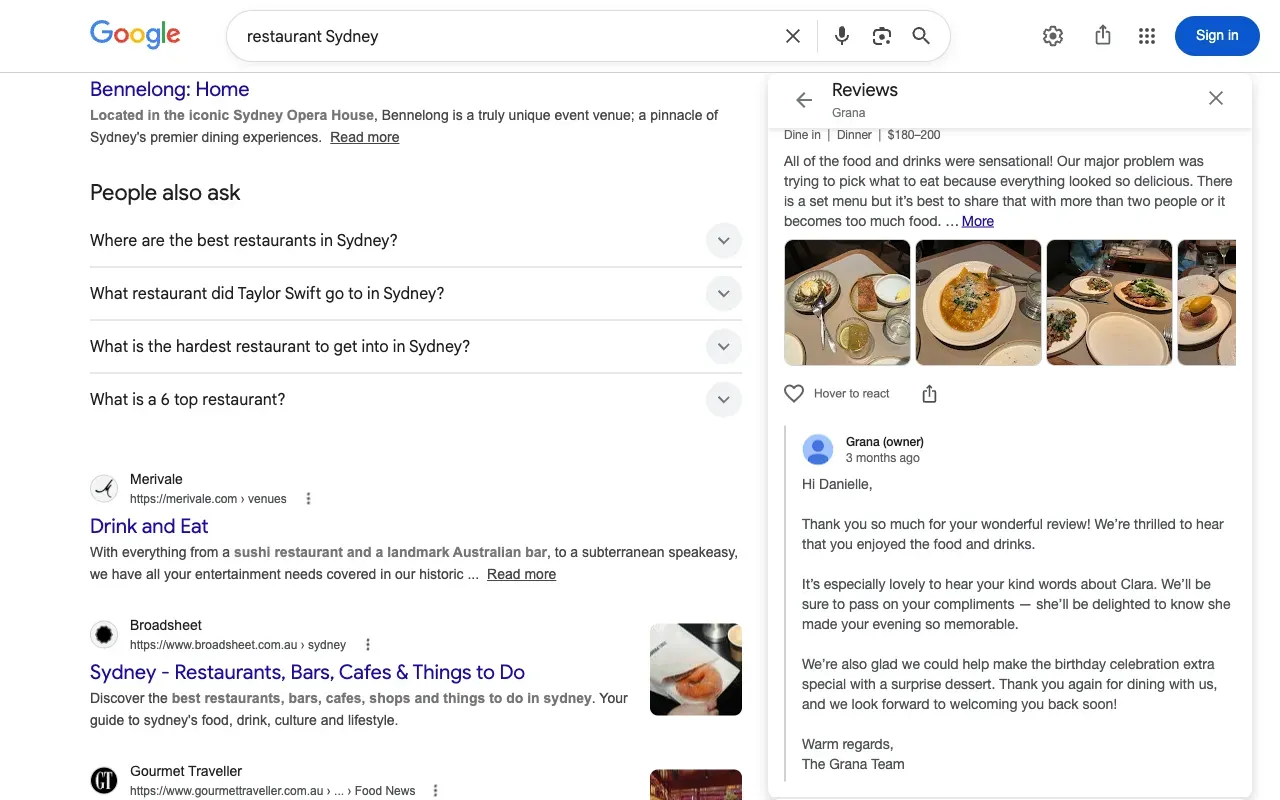
- Acknowledges something specific from the review (shows you actually read it)
- Includes a natural mention of your service or location (the same suburb and service terms you’d identify through local SEO keyword research are worth weaving in here for the same reason)
- Is warm without being sycophantic
Example:
“Thank you, Sarah. Really glad the kitchen renovation came together the way you imagined. Working in the Newtown terrace format is always a fun challenge. Looking forward to seeing the bathroom project when you’re ready.”
Notice: it mentions the specific job, includes a Sydney suburb naturally, and ends with a forward-looking line. It doesn’t say “We really appreciate your business” three times.
Avoid copy-pasting the same response to every positive review. Reviewers and future customers both notice. It signals automation, not genuine engagement.
How Do You Respond to Negative Google Reviews?
This is where most small business owners struggle. The instinct is either to ignore the review or to defend yourself. Neither works.
A negative review response has one job: demonstrate to future customers that your business takes concerns seriously and handles problems professionally.
The structure that works:
- Acknowledge the experience without admitting fault for things that aren’t accurate
- Express genuine concern that the experience fell short
- Take the conversation offline by offering a direct contact method
- Keep it short
Example:
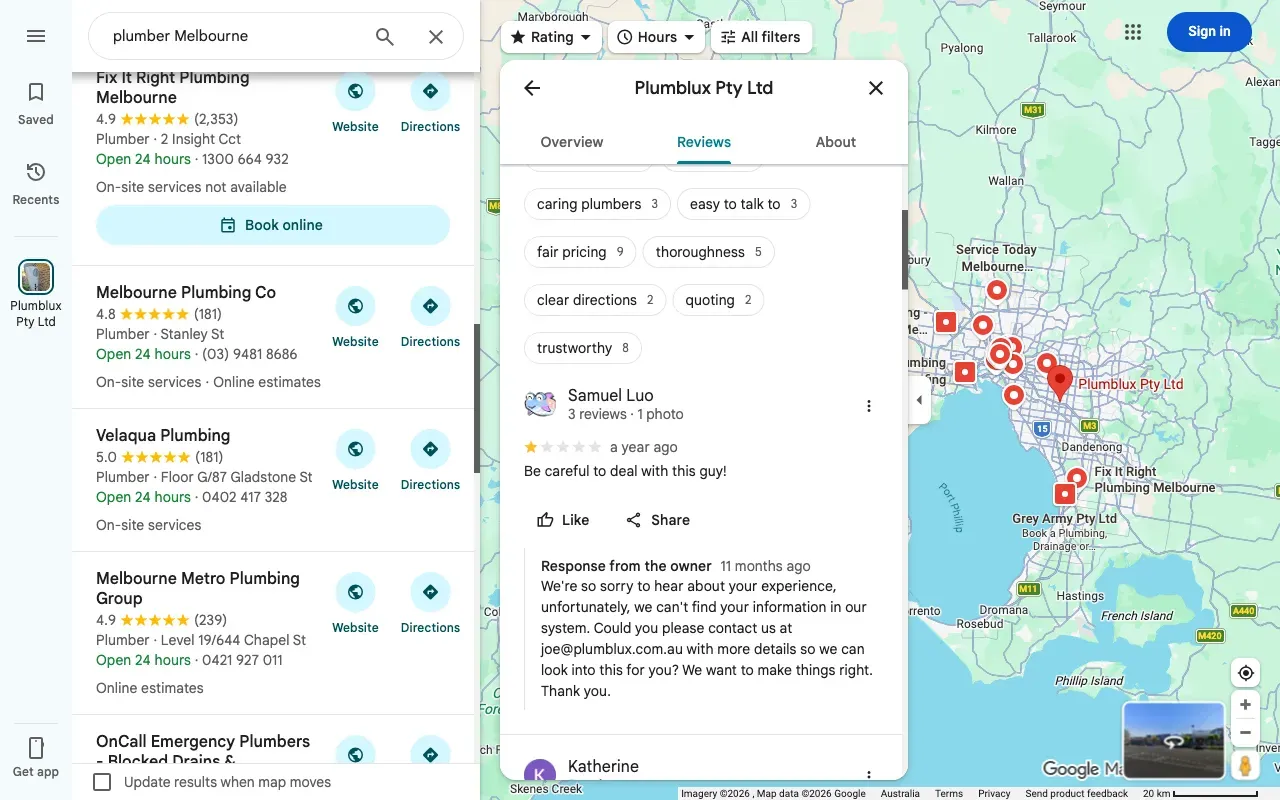
“Thank you for the feedback, James. I’m sorry to hear the installation didn’t go as smoothly as expected. That’s not the standard we aim for. I’d like to understand what happened and make it right. Please contact me directly at [email] so we can sort this out.”
What this response does: it’s calm, it’s professional, it doesn’t argue, and it signals to every other reader that this business owner is reasonable and responsive.
What to avoid:
- Arguing the facts publicly
- Questioning the reviewer’s honesty
- Lengthy explanations of why the reviewer is wrong
- Passive-aggressive language (“We’re sorry you feel that way”)
If the review is factually incorrect, you can state the facts briefly and calmly, then offer to resolve offline. One sentence is enough.
How Do You Respond to Google Reviews You Suspect Are Fake?
Fake reviews are a real problem for Australian small businesses, particularly in competitive local markets. If you receive a review from someone who was never a customer, you have two options.
First, report it to Google via the flag function on the review. Google’s process for removal is slow and inconsistent, but genuine violations of their review policy (fake reviews, reviews from competitors) do get removed, though it takes time and follow-up.
Second, respond calmly. Even if you suspect the review is fake, a public argument looks worse than a measured response. Something like: “I’ve looked through our customer records and I’m unable to find any record of this visit. If there’s been a case of mistaken identity, I’d welcome the chance to discuss; please contact us directly.”
Do not offer incentives, refunds, or any benefit in exchange for a reviewer updating or removing a negative review. This violates Google’s review policy and the ACCC guidelines on review manipulation.
How to Actually Post a Response
- Go to business.google.com and sign in
- Click on Reviews in the left menu
- Find the review you want to respond to
- Click Reply and write your response
- Click Post reply
Aim to respond within 24 to 48 hours of a review appearing. Prompt responses signal an active, attentive business.
Common Questions
How do I reply to a positive Google review?
Acknowledge something specific from the review, include a natural mention of your service or location, and keep it brief and genuine. Avoid copy-pasting the same response to every review.
How do you say thank you for a Google review without sounding generic?
Reference something specific they mentioned. If they mentioned a staff member, name the staff member. If they mentioned the job type or location, include it naturally. Specificity is what separates a real response from a template.
Why won’t Google let me reply to a review?
Usually because the Google account managing your GBP isn’t the owner account, or because the review has been flagged and is under review. Check that you’re signed into the correct account at business.google.com.
Should I respond to every review?
Yes, eventually. Prioritise negative reviews first (respond within 24 hours), then work through positive reviews. Volume of responses is less important than quality and promptness on the reviews that matter most.
Responding to Google reviews takes ten minutes a week. It is one of the highest-value, lowest-effort tasks in local SEO, not because it directly shifts your ranking, but because every response is permanent, public, and read by every future customer who researches your business.
If you want a local SEO consultant Sydney to audit your GBP activity, including how your current reviews and responses are affecting your local search presence, book a call and I’ll give you a specific assessment.
Jay Ong is a Local SEO Consultant based in Sydney, helping Australian small businesses rank higher on Google Maps and attract more local customers.