An electrical contractor came to me after six months of content he had paid an agency to produce. The articles were ranking. Not for anything useful. He was showing up for “electrician” and “electrical services”: national terms with no geographic modifier, driven almost entirely by searchers in other states. His phone wasn’t ringing from the content because none of it was reaching people in his service area.
The work wasn’t wrong. It was targeted at the wrong keywords. Local SEO keyword research is a different task from national SEO keyword research, and most small business owners either skip it entirely or borrow generic keyword lists that aren’t built around how their actual customers search.
This guide covers how to find the right local keywords for your business, which free tools work for Australian businesses, and how to decide what to target first.
What Makes Local SEO Keywords Different from National Keywords?
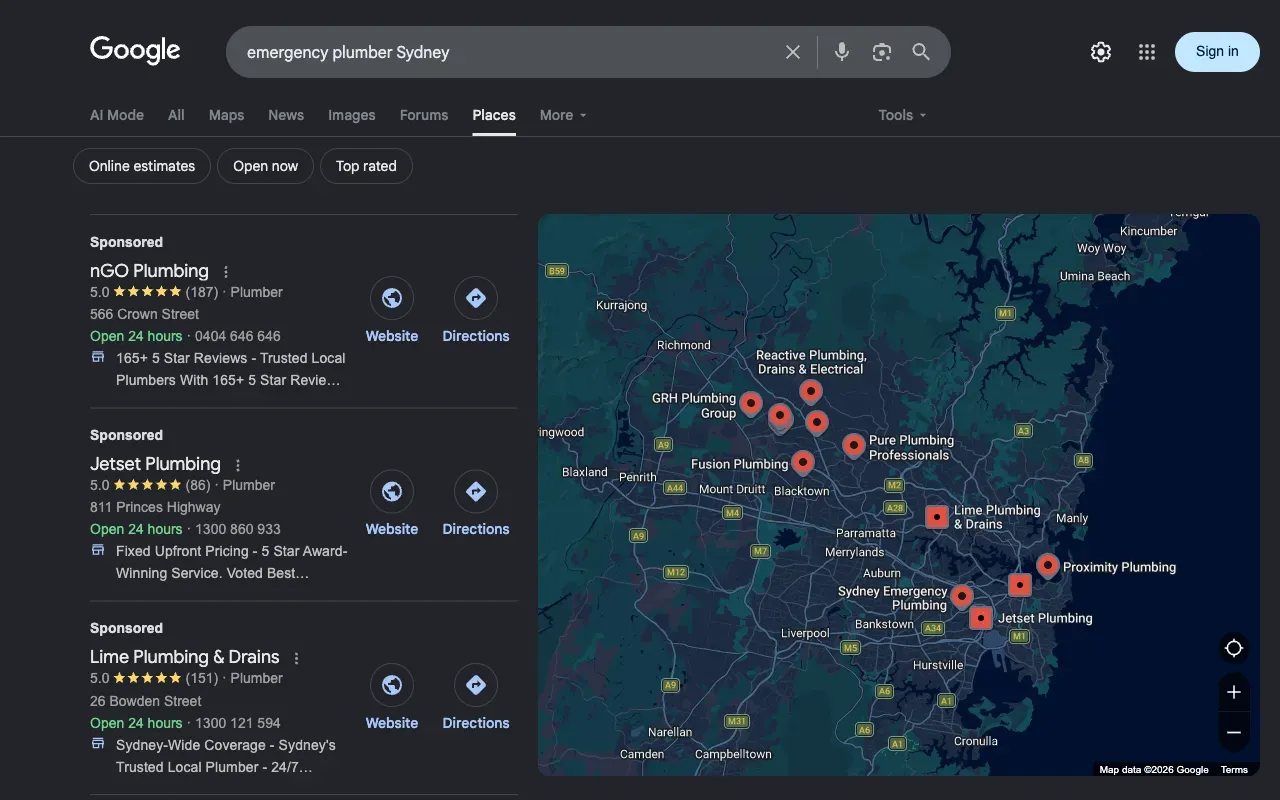
A local SEO keyword targets a topic plus a location, whereas a national keyword targets a topic alone: “how to fix a leaking tap.” A local keyword targets a topic plus a location: “plumber Parramatta” or “emergency plumber Western Sydney.”
Local keywords have lower search volume than national terms. That’s fine. A plumber in Parramatta who ranks in the map pack and organic results for “plumber Parramatta” is reaching people who can actually become customers. Ranking for “plumber” nationally reaches people you can never serve.
The other difference is intent. Local search queries almost always signal immediate or near-term commercial intent. Someone searching “dentist Bondi” is not researching dentistry. They need a dentist. That specificity is what makes local keyword rankings valuable; the traffic converts at a much higher rate than broad informational traffic.
What Are the Two Types of Local Keywords to Target?
Service + Location Keywords
These are the primary targets for most local businesses. The formula is: what you do + where you do it.
- “electrician Penrith”
- “cafe Newtown”
- “physio North Sydney”
- “accountant Parramatta”
You need a version of these for each core service and each suburb or area you serve. For a business serving multiple suburbs, this generates a meaningful list of targets quickly.
Problem or Intent Keywords with Location
These capture searchers earlier in the decision process, or those using more natural language:
- “best electrician near me” (Google maps “near me” to your location)
- “emergency plumber open now Sydney”
- “cheap accountant western suburbs Melbourne”
- “trusted dentist for kids Chatswood”
These are lower volume but often higher intent. The searcher using “emergency plumber open now” is not comparison shopping.
Which Free Tools Work for Australian Local SEO Keyword Research?
Google Keyword Planner
The most reliable source of Australian search volume data. Set your location to Australia (or a specific state) before pulling volume data; the default is global and will mislead you on how competitive and how searched a term actually is locally.
To access it: Google Ads account required (free to create, no need to run ads). Search a seed keyword, set location to Australia, and review monthly search volumes and competition levels.
One caveat: Keyword Planner groups keywords with similar volume into ranges rather than exact numbers when your account hasn’t spent money on ads. The ranges are still useful for relative prioritisation: “100–1,000” vs “10–100” tells you enough.
Google Search Console
If your website is already live and indexed, Search Console shows you what keywords you’re already appearing for and what position you’re in. This is the most practical starting point because you’re building on what Google already associates with your site.
Filter by country (Australia) and look at the queries report. Keywords where you’re ranking on page two or three (positions 11–30) are your fastest-win opportunities: you’re already relevant, you just need to improve.
Google Autocomplete
Type your core service into Google Search without hitting enter and read the suggested completions. These are real searches made by real people in Australia. They tell you exactly how your customers phrase their searches.
“plumber syd” → “plumber Sydney,” “plumber Sydney emergency,” “plumber Sydney eastern suburbs,” “plumber Sydney no call out fee”
Do this for every core service and note the location modifiers and intent signals that appear.
Google Trends
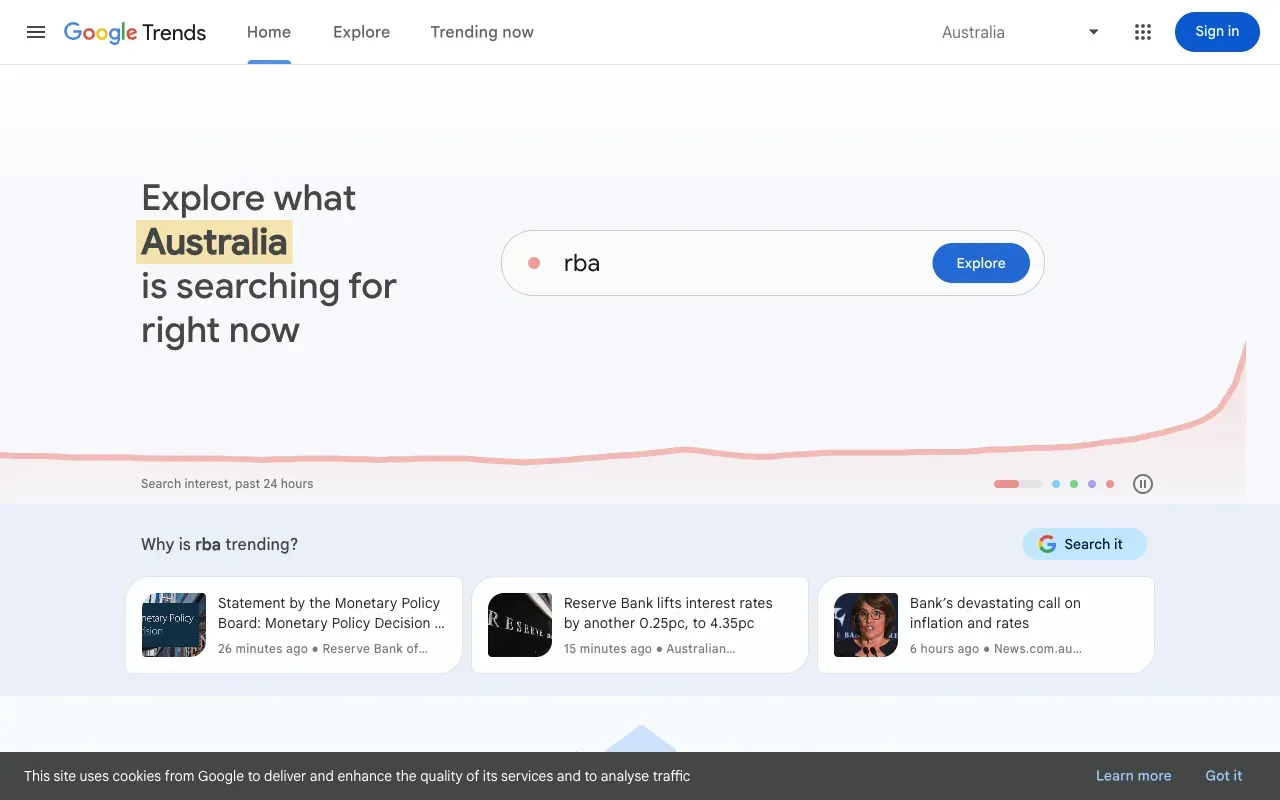
Set the region to Australia and compare search interest between keyword variations. Useful for seasonal patterns (“pool cleaning” spikes before summer) and for comparing phrasing (“tradesman” vs “tradie”; tradesman wins in search volume despite tradie being more common in conversation).
How to Build Your Local Keyword List
Start with your services. List every distinct service you offer. For each service, write the most direct search phrase: what would someone type if they needed this service right now in your area?
Then apply location modifiers at three levels:
- Primary suburb: where your business is located or where most of your customers come from
- Adjacent suburbs: the surrounding areas you actively serve
- Broader region: the city or region level (Western Sydney, Inner Melbourne, South East Queensland)
For a physio in Crows Nest, that generates:
- “physiotherapist Crows Nest”
- “physio Crows Nest”
- “sports physio Crows Nest”
- “physiotherapist North Sydney” (adjacent)
- “physio St Leonards” (adjacent)
- “physiotherapist North Shore Sydney” (broader region)
Run each variation through Google Keyword Planner to check volume, and Google Autocomplete to confirm real phrasing. Delete any that have zero search suggestion and no Planner data; some suburb-level combinations simply aren’t searched.
How to Prioritise What to Target First
Not all keywords are worth equal effort. Prioritise using three filters:
Commercial intent. “Plumber Parramatta” has higher intent than “how to fix a leaking tap Parramatta.” Target the high-intent service terms first.
Search volume relative to competition. A keyword with 100 searches per month and weak competitors (thin pages, poor GBP optimisation) is a better early target than a keyword with 500 searches and established local operators dominating the map pack.
Your current position. Keywords where you’re already on page two (positions 11–20) convert fastest. The lift from position 15 to position 3 is less work than ranking for a term you don’t appear for at all.
For most small businesses starting local SEO, the order is:
- Your business name + primary service + primary suburb (the exact match local term)
- Service + adjacent suburbs (geographic expansion)
- Service + broader region terms (higher volume, higher competition, longer timeline)
- Problem and intent-based local terms (supplementary content targets)
How Do You Map Local Keywords to Pages on Your Website?
Each distinct local keyword cluster should map to a specific page on your website.
Your homepage targets your primary service + city (“electrician Sydney”). Suburb-specific pages (sometimes called location pages) target individual suburb terms (“electrician Penrith,” “electrician Blacktown”). Blog content targets problem-intent keywords (“how long does it take to rewire a house in Sydney”).
The mistake most small businesses make is trying to target every keyword from a single page. Google needs clear signals that a specific page is the best result for a specific query. One keyword cluster per page is the working principle. The same suburb and service terms are also worth using naturally when responding to Google reviews, where mentioning your location and service type in positive replies reinforces the same local signals your pages are targeting.
Common Mistakes
Targeting city-level terms before suburb-level terms. “Plumber Sydney” is significantly more competitive than “plumber Parramatta.” Start with the more specific terms where the competition is weaker, establish rankings, then build toward broader terms.
Ignoring how customers actually phrase things. Tools give you data, but listening to how customers describe your service on the phone is often more accurate. If every caller says “I need someone to sort my hot water system,” that phrase has keyword value.
Treating “near me” as a target keyword. You can’t optimise for “plumber near me” the same way you can for a specific suburb. “Near me” searches are resolved by Google using the searcher’s location. The way to rank for “near me” searches is to have a well-optimised GBP in the right location, not to target the phrase itself in your content.
Building keyword lists and never using them. A keyword list is only useful if it drives page creation, content decisions, and GBP optimisation choices. The list is the input, not the output.
Common Questions
How many keywords should I target?
For a single-location business, focus on 5–15 primary local keywords covering your core services and primary suburbs. That’s enough to build meaningful pages and GBP signals without spreading your effort too thin.
Do I need paid keyword tools for local SEO?
No. Google Keyword Planner, Search Console, Autocomplete, and Google Trends cover the fundamentals at no cost. Paid tools like Ahrefs or SEMrush add competitor keyword data and more precise volume figures, but they’re not necessary to start.
Should I target the same keyword on multiple pages?
No. Two pages targeting the same keyword compete with each other in Google’s index (known as keyword cannibalism). One clear page per keyword cluster produces better results than multiple diluted pages.
How often should I update my keyword research?
Review your Search Console quarterly. New keywords you’re appearing for, shifts in position, and new competitor pages all create opportunities for refinement. A full keyword research refresh annually is sufficient for most local businesses.
Keyword research for local SEO is not a one-time task, but the foundational pass, identifying your primary service and suburb targets, takes a few hours and doesn’t require specialist tools. What it does require is being specific about the geography you actually serve. Once those targets are set, building local links is what creates the authority to outrank established competitors for the more competitive terms.
If you want a local SEO specialist to build your keyword list and map it to a page structure that’s actually set up to rank, book a call and I’ll show you exactly what your current site is and isn’t targeting.
Jay Ong is a Local SEO Consultant based in Sydney, helping Australian small businesses rank higher on Google Maps and attract more local customers.